Common Queries
Here's a collection of common queries you can use with Data Connect. Copy and paste these queries into your BI tool or run them directly on your cluster. Some queries may require you to update property names, event names, or date ranges to fit your specific needs.
Basic Queries
Section titled Basic QueriesEvent Counts
Section titled Event CountsSELECT device_type ,plan ,COUNT(session_id)FROM main_production.sessions AS sessionsINNER JOIN main_production.users AS users ON sessions.user_id = users.user_idGROUP BY 1, 2Average Property Value
Section titled Average Property ValueSELECT [Property_to_Group_By], AVG([Numeric_Property])FROM main_production.[event_name]GROUP BY 1ORDER BY 1Aggregate Metrics
Section titled Aggregate MetricsIn this section, you'll find various queries to measure aggregate metrics for your site, including average time, top events, and more. The value of these queries increases as you segment them by user personas, and the same logic can also be applied to calculate more specific statistics.
Top 10 Events
Section titled Top 10 EventsThe top 10 events shed light on how users are interacting with your app. Looking at this list generates a lot of questions: Why are users selecting this button? Why are users viewing this page? Are these two actions correlated? Does the high event count come from users' success within the product, or is this caused by confusion?
You can modify the WHERE statement to adjust the date range. You can include the date in the SELECT statement and GROUP BY clause to measure how the most frequently performed actions change over time. You can also adjust the number of events you are looking at by modifying the LIMIT.
SELECT all_events.event_table_name AS "Event" ,COUNT(*) AS "Event Count"FROM main_production.all_events AS all_eventsWHERE time >= DATEADD(day, -30, getdate())GROUP BY 1ORDER BY 2 DESCLIMIT 10Average Time on Site
Section titled Average Time on SiteThis query is primarily beneficial to you if you have a content site, and there aren't a lot of user interactions to capture while reading, and avid readers don't always comment or share. Although this is a proxy for engagement, drastic changes in time on site can cue you in to investigate how users are engaging with your product.
You can tweak this query to analyze average time between events, or break it down into different segments of users to get a better understanding of your site's usage.
SELECT ROUND(AVG(duration)::FLOAT, 4) "Average Session time in Minutes"FROM ( SELECT session_id || '-' || user_id AS "unique" ,MIN(time) AS "start" ,MAX(time) AS "last" ,((DATEDIFF('milliseconds', MIN(time), MAX(time))::FLOAT / 1000) / 60) AS "duration" FROM main_production.all_events -- modify your date range here WHERE time >= DATEADD('month', -2, getDate()) GROUP BY 1)Average Time on Page
Section titled Average Time on PageWITH ordered_pageviews AS ( SELECT * ,row_number() OVER (PARTITION BY user_id, session_id ORDER BY TIME ASC) AS rn FROM main_production.pageviews WHERE TIME >= DATEADD('month', -1, getDate()))SELECT a.path ,avg(pageview_time) / 60 as avg ,round(percentile_cont(0.25) within group (order by pageview_time) / 60, 2) as p25 ,round(percentile_cont(0.5) within group (order by pageview_time) / 60, 2) as median ,round(percentile_cont(0.75) within group (order by pageview_time) / 60, 2) as p75 ,round(percentile_cont(0.9) within group (order by pageview_time) / 60, 2) as p90FROM ( SELECT p1.session_id ,p1.user_id ,p1.path ,datediff('seconds', p1.time, p2.time) AS pageview_time FROM ordered_pageviews p1 JOIN ordered_pageviews p2 ON p1.session_id = p2.session_id AND p1.user_id = p2.user_id AND p1.rn + 1 = p2.rn -- optional filter to limit paths you're analyzing -- WHERE p1.path !~ '/app' GROUP BY p1.session_id, p1.user_id, p1.path, p1.time, p2.time) aGROUP BY 1ORDER BY 2 DESC;Average Events per Session
Section titled Average Events per SessionThe average events per session metric can give you insight into aggregate behavior.
This query can also be modified to analyze behavior across segments and over time, allowing you to answer questions such as: Does this number change with a product launch or tweaks to the onboarding flow? Do different types of users interact differently? Changes in the average can prompt investigation into what is really happening within your app.
SELECT Round(Count(DISTINCT event_id)::DECIMAL / Count(DISTINCT session_id), 2) AS "average"FROM main_production.all_events-- modify your date range hereWHERE TIME >= Dateadd('day', -30, Getdate())Average Events per Session Over Time
Section titled Average Events per Session Over TimeTo modify this query to calculate the average number of events per session over the past year or past six months, update the WHERE statement to include the time range and add a GROUP BY clause to address the granularity.
SELECT TO_CHAR(main_production.all_events.time, 'YYYY-MM') as month ,ROUND(COUNT(DISTINCT event_id)::DECIMAL / COUNT(DISTINCT session_id), 2) AS "average"FROM main_production.all_events-- modify your date range hereWHERE time >= DATEADD('month', -6, getdate())GROUP BY 1Average Events per Session by User Property
Section titled Average Events per Session by User PropertyTo calculate this, join the all events table on the user table and add a GROUP BY clause based on the user properties you want to use for segmentation.
SELECT user_property ,ROUND(COUNT(DISTINCT event_id)::DECIMAL / COUNT(DISTINCT session_id), 2) AS "average"FROM main_production.all_eventsJOIN main_production.usersON main_production.all_events.user_id = main_production.users.user_id-- modify your date range hereWHERE time >= DATEADD('day', -30, getdate())GROUP BY 1Average Sessions per User
Section titled Average Sessions per UserThe average number of sessions per user can be used in the same way as average events per session and can be modified in the same manner. To find the average number of sessions per user, divide the number of unique sessions by the number of unique users across the time period.
SELECT ROUND(COUNT(DISTINCT session_id)::DECIMAL / COUNT(DISTINCT user_id), 2)FROM main_production.sessions-- modify the date range hereWHERE time >= DATEADD('day', -30, GETDATE())Average Sessions Before Signup
Section titled Average Sessions Before Signup(or any other event)
WITH first_signup AS ( SELECT user_id, min(time) AS first_time FROM main_production.sign_up GROUP BY 1),sessions_pre_signup AS ( SELECT sessions.user_id, count(distinct session_id) AS total_sessions FROM main_production.sessions JOIN first_signup ON first_signup.user_id = sessions.user_id AND sessions.time <= first_signup.first_time GROUP BY 1)SELECT avg(total_sessions)FROM sessions_pre_signupBounce Rate
Section titled Bounce RateWITH data AS ( SELECT time::date AS day, session_id, count(*) AS pageviews FROM heap_production.pageviews GROUP BY 1, 2)SELECT day, count(CASE WHEN pageviews = 1 THEN 1 ELSE NULL END) / count(*) AS bounce_rateFROM dataGROUP BY 1ORDER BY 1Month-to-Month Retention
Section titled Month-to-Month Retention-- get a cohort based on join dateWITH new_user_activity AS ( SELECT activity.user_id ,activity.TIME AS DATE FROM main_production.sessions AS activity INNER JOIN users ON users.user_id = activity.user_id AND users.joindate = activity.TIME WHERE date_part('year', joindate) >= 2014),-- number of users in cohortcohort_active_user_count AS ( SELECT to_char(DATE, 'YYYY-MM') AS DATE ,count(DISTINCT user_id) AS count FROM new_user_activity GROUP BY 1)-- change format to change granularitySELECT joindate ,period ,new_users ,retained_users ,retentionFROM ( SELECT to_char(new_user_activity.DATE, 'YYYY-MM') AS "joindate" ,'Month ' || -- change month to change granularity datediff('month', new_user_activity.DATE, future_activity.TIME) AS period ,max(cohort_size.count) AS new_users ,-- all equal in group count(DISTINCT future_activity.user_id) AS retained_users ,round(count(DISTINCT future_activity.user_id) / max(cohort_size.count)::DECIMAL, 2) AS retention FROM new_user_activity LEFT JOIN main_production.sessions AS future_activity ON new_user_activity.user_id = future_activity.user_id AND new_user_activity.DATE <= future_activity.TIME LEFT JOIN cohort_active_user_count AS cohort_size ON to_char(new_user_activity.DATE, 'YYYY-MM') = cohort_size.DATE GROUP BY 1, 2) tWHERE period IS NOT NULLORDER BY 1, 2Funnels
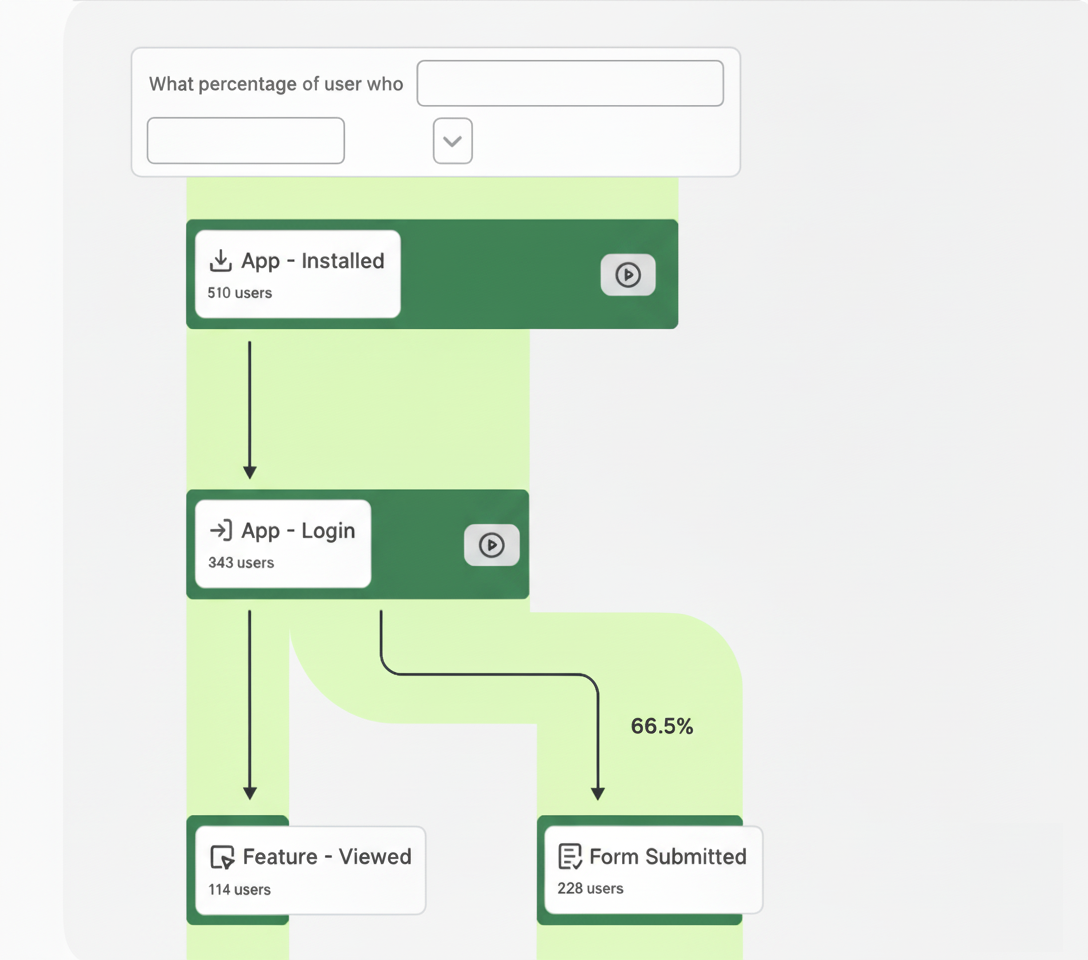
Section titled FunnelsThis section covers Data Connect queries that enable you to conduct funnel analysis by measuring all types of funnels. Funnels are fundamental to understanding any flow through your site, from onboarding to filling out forms, to virtually any step users are expected to take within your product.
The Basic Funnel
Section titled The Basic FunnelThe funnel below can be used to mirror the funnel in Contentsquare's dashboard. It calculates the number of users who have completed Step 1 within the time frame, the number of users who have completed Step 2, and then Step 3. It's both sequential and time-constrained, though there are many modifications you may wish to make, as shown below.
WITH e1 AS ( SELECT DISTINCT user_id ,1 AS step_1 ,MIN(time) AS step_1_time -- change to table name of event 1 in your funnel FROM main_production.step_1 AS e1 WHERE time BETWEEN '2016-04-13' AND '2016-04-21' GROUP BY 1),e2 AS ( SELECT e1.user_id ,1 AS step_2 ,MIN(time) AS step_2_time -- change to table name of event 2 in your funnel FROM main_production.step_2 AS e2 INNER JOIN e1 ON e1.user_id = e2.user_id WHERE time BETWEEN step_1_time AND '2016-04-21' GROUP BY 1),e3 AS ( SELECT e3.user_id ,1 AS step_3 ,MIN(time) AS step_3_time -- change to table name of event 3 in your funnel FROM main_production.step_3 AS e3 INNER JOIN e2 ON e2.user_id = e3.user_id WHERE TIME BETWEEN step_2_time AND '2016-04-21' GROUP BY 1)SELECT SUM(step_1) AS "Step 1" ,SUM(step_2) AS "Step 2" ,SUM(step_3) AS "Step 3" ,ROUND(SUM(step_2)/SUM(step_1)::DECIMAL, 2) as step_1to2_conversion ,ROUND(SUM(step_3)/SUM(step_2)::DECIMAL, 2) as step_2to3_conversion ,ROUND(SUM(step_3)/SUM(step_1)::DECIMAL, 2) as overall_conversionFROM ( SELECT e1.user_id ,step_1 ,step_1_time ,step_2 ,step_2_time ,step_3 ,step_3_time FROM e1 LEFT JOIN e2 ON e1.user_id = e2.user_id LEFT JOIN e3 ON e2.user_id = e3.user_id)Funnels Grouped by an Event-Level Property
Section titled Funnels Grouped by an Event-Level PropertyEach event has a set of properties ranging from attributes Contentsquare captures automatically, like referrer, UTM parameters, and device type, as well as any properties you set using snapshots, heap.addEventProperties, or heap.track.
To view a breakdown of the conversion rate based on these event-level properties, only a couple of modifications need to be made. In the funnel, include the event-level property in the SELECT statement and GROUP BY clause. You can also join this on the users table (JOIN main_production.users on main_production.users.user_id=e1.user_id) to analyze your conversion rates based on user-level properties as well.
WITH e1 AS ( SELECT DISTINCT e1.user_id ,1 AS step_1 ,min(TIME) AS step_1_time ,utm_source FROM main_production.define_event AS e1 INNER JOIN ( SELECT user_id ,min(TIME) AS mintime FROM main_production.define_event WHERE DATE(TIME) BETWEEN '2016-04-13' AND '2016-04-20' GROUP BY 1 ) AS min_value ON e1.user_id = min_value.user_id AND e1.TIME = min_value.mintime WHERE DATE(TIME) BETWEEN '2016-04-13' AND '2016-04-20' GROUP BY 1, 4),e2 AS ( SELECT e1.user_id ,1 AS step_2 ,MIN(time) AS step_2_time -- change to table name of event 2 in your funnel FROM main_production.step_2 AS e2 INNER JOIN e1 ON e1.user_id = e2.user_id WHERE time BETWEEN step_1_time AND '2016-04-21' GROUP BY 1),e3 AS ( SELECT e3.user_id ,1 AS step_3 ,MIN(time) AS step_3_time -- change to table name of event 3 in your funnel FROM main_production.step_3 AS e3 INNER JOIN e2 ON e2.user_id = e3.user_id WHERE TIME BETWEEN step_2_time AND '2016-04-21' GROUP BY 1)SELECT utm_source ,sum(step_1) AS "Step 1" ,sum(step_2) AS "Step 2" ,sum(step_3) AS "Step 3"FROM ( SELECT e1.user_id ,step_1 ,step_1_time ,step_2 ,step_2_time ,step_3 ,step_3_time ,utm_source FROM e1 LEFT JOIN e2 ON e1.user_id = e2.user_id LEFT JOIN e3 ON e2.user_id = e3.user_id)GROUP BY 1Restricting Funnels to One Session
Section titled Restricting Funnels to One SessionIn this funnel, user ID and session ID are aligned to make sure that funnel spans across one session. There are a couple of tweaks needed in each step of the query.
WITH e1 AS ( SELECT DISTINCT user_id ,session_id ,Min(time) AS step_1_time -- change to table name of event 1 in your funnel FROM main_production.step_1 AS e1 WHERE time BETWEEN '2016-04-13' AND '2016-04-21' GROUP BY 1, 2),e2 AS ( SELECT e1.user_id ,e1.session_id ,Min(time) AS step_2_time -- change to table name of event 2 in your funnel FROM main_production.step_2 AS e2 INNER JOIN e1 ON e1.user_id = e2.user_id AND e1.session_id = e2.session_id WHERE time BETWEEN step_1_time AND '2016-04-21' GROUP BY 1, 2),e3 AS ( SELECT e3.user_id ,e3.session_id ,Min(time) AS step_3_time -- change to table name of event 3 in your funnel FROM main_production.step_3 AS e3 INNER JOIN e2 ON e2.user_id = e3.user_id AND e2.session_id = e3.session_id WHERE time BETWEEN step_2_time AND '2016-04-21' GROUP BY 1, 2)SELECT count(DISTINCT step_1) as step_one ,count(DISTINCT step_2) AS step_two ,count(DISTINCT step_3) AS step_three ,round(count(DISTINCT step_3)/count(DISTINCT step_1)::decimal, 2) AS conversion_rate-- calculate additional percentages hereFROM ( SELECT e1.user_id AS step_1 ,e1.session_id ,step_1_time ,e2.user_id AS step_2 ,step_2_time ,e3.user_id AS step_3 ,step_3_time FROM e1 LEFT JOIN e2 ON e1.user_id = e2.user_id AND e1.session_id = e2.session_id LEFT JOIN e3 ON e2.user_id = e3.user_id AND e2.session_id = e3.session_id ORDER BY 1)Conversion Rate Over Time
Section titled Conversion Rate Over TimeThis report gives the user a window to complete the funnel and tracks how your conversion changes over time.
WITH e1 AS ( SELECT DISTINCT user_id ,1 AS step_1 ,MIN(time) AS step_1_time ,TO_CHAR(e1.time, 'YYYY-MM') as "month" FROM main_production.[event_1] AS e1 WHERE TIME BETWEEN '2015-04-01' AND '2016-04-01' GROUP BY 1, 4),e2 as ( SELECT e1.user_id, 1 AS step_2, MIN(e2.time) AS step_2_time, e1.step_1_time FROM main_production.[event_2] AS e2 JOIN e1 ON e1.user_id=e2.user_id AND e1.step_1_time <= DATEADD('day', -30, e2.time) WHERE time BETWEEN step_1_time AND '2016-04-01' GROUP BY 1, 4),e3 as ( SELECT e3.user_id, 1 AS step_3, MIN(time) AS step_3_time, e2.step_1_time FROM main_production.[event-3] AS e3 JOIN e2 ON e2.user_id=e3.user_id AND e2.step_1_time <= DATEADD('day', -30, e3.time) WHERE time BETWEEN step_2_time AND '2016-04-01' GROUP BY 1, 4)SELECT MONTH, ROUND(SUM(step_3)/SUM(step_1)::DECIMAL, 2) AS "Conversion Rate"FROM ( SELECT e1.user_id, step_1, e1.step_1_time, step_3, step_3_time, e1.month FROM e1 LEFT JOIN e2 ON e1.user_id = e2.user_id AND e1.step_1_time=e2.step_1_time LEFT JOIN e3 ON e2.user_id= e3.user_id AND e2.step_1_time=e3.step_1_time)GROUP BY 1ORDER BY 1Time to Conversion
Section titled Time to ConversionTime can be an interesting metric to analyze. The time it takes for a user to make their first purchase from the date first seen, or the time it takes a user to fill out a form from the first field to submit, or the time between two purchases can be measured and optimized. You can analyze which behaviors, user properties, or first touch properties are associated with faster conversion rates.
This example measures the time it takes users to purchase an item but can be adapted to measure a slew of different events, and segmented by a variety of user and event-level properties.
SELECT avg(duration) AS "Average hours until Purchase"FROM ( SELECT user_id ,datediff('milliseconds', start_time, end_time)::DECIMAL / 1000 / 60 / 60 AS "duration" FROM ( SELECT main_production.users.user_id ,min(joindate) AS start_time ,min(main_production.purchase.time) AS end_time FROM main_production.sign_up JOIN main_production.users ON main_production.purchase.user_id = main_production.users.user_id GROUP BY 1 ))Path Analysis
Section titled Path AnalysisThis query allows you to track the most common flows or 'paths' into and out of your product via Data Connect.
As is, the SQL selects the first 5 events of every session consisting of at least five events. It then aggregates the number of users who have completed each flow and displays the top 20 most common paths.
WITH event_count AS ( SELECT event_table_name ,count(*) AS cardinality FROM main_production.all_events WHERE TIME >= dateadd('day', -30, getDate()) GROUP BY 1),all_events AS ( SELECT DISTINCT event_id ,main_production.all_events.user_id AS user_id ,main_production.all_events.event_table_name AS event_name ,main_production.all_events.TIME AS occurred_at ,cardinality AS number FROM main_production.all_events LEFT JOIN event_count ON main_production.all_events.event_table_name = event_count.event_table_name ORDER BY 1, 2),events AS ( SELECT all_events.user_id ,all_events.event_id ,event_name ,occurred_at ,cardinality FROM all_events INNER JOIN ( SELECT event_id ,user_id ,min(number) AS cardinality FROM all_events GROUP BY 1, 2 ) AS event ON all_events.number = event.cardinality AND all_events.event_id = event.event_id AND all_events.user_id = event.user_id ORDER BY 1, 2, 4)SELECT e1, e2, e3, e4, e5 ,COUNT(*) AS occurrencesFROM ( -- Pivot out first five events in each session SELECT user_id ,session ,MAX(CASE WHEN event_number = 1 THEN event_name ELSE NULL END) AS e1 ,MAX(CASE WHEN event_number = 2 THEN event_name ELSE NULL END) AS e2 ,MAX(CASE WHEN event_number = 3 THEN event_name ELSE NULL END) AS e3 ,MAX(CASE WHEN event_number = 4 THEN event_name ELSE NULL END) AS e4 ,MAX(CASE WHEN event_number = 5 THEN event_name ELSE NULL END) AS e5 FROM ( -- Find event number in session SELECT z.* ,ROW_NUMBER() OVER (PARTITION BY user_id, session ORDER BY occurred_at) AS event_number FROM ( -- Sum breaks to find sessions SELECT y.* ,SUM(BREAK) OVER (ORDER BY user_id, occurred_at ROWS UNBOUNDED PRECEDING) AS session FROM ( -- Add flag if last event was more than 10 minutes ago SELECT x.* ,CASE WHEN last_event IS NULL OR occurred_at >= last_event + INTERVAL '10 MINUTE' THEN 1 ELSE 0 END AS BREAK FROM ( -- Find last event SELECT * ,LAG(occurred_at, 1) OVER (PARTITION BY user_id ORDER BY occurred_at) AS last_event FROM events ) x ) y ) z ) a WHERE event_number <= 5 GROUP BY 1, 2) finalWHERE e1 IS NOT NULLAND e2 IS NOT NULLAND e3 IS NOT NULLAND e4 IS NOT NULLAND e5 IS NOT NULLGROUP BY 1, 2, 3, 4, 5ORDER BY 6 DESCLIMIT 20Attribution
Section titled AttributionThis section covers Data Connect queries that enable you to measure attribution to better understand where your users are coming from.
Top Referrers
Section titled Top ReferrersThis query returns the top N referrers and the number of sessions they generate.
SELECT referrer ,COUNT(*) AS sessionsFROM main_production.sessionsWHERE referrer IS NOT NULLGROUP BY 1ORDER BY 2 DESCLIMIT 10First Touch Properties
Section titled First Touch PropertiesThis query generates a table that matches Contentsquare's Users view. You can export and select all the user-level properties and all the first touch properties.
How it works
Section titled How it worksThis query starts by calculating the first session for each user and joins the first sessions data with the users table based on the unique user ID. From here, each user-level property and session-level property can be selected.
SELECT all_sessions.user_id ,first_session.first_time AS first_seen ,referrer ,utm_source ,utm_campaign ,utm_medium ,utm_contentFROM main_production.sessions AS all_sessionsINNER JOIN ( SELECT user_id ,MIN(time) AS first_time FROM main_production.sessions GROUP BY user_id) AS first_sessionON all_sessions.user_id = first_session.user_idAND all_sessions.time = first_session.first_timeINNER JOIN main_production.users AS usersON all_sessions.user_id = users.user_id-- [optional] insert where clause hereORDER BY 3 DESCFirst Touch Property by User Count
Section titled First Touch Property by User CountThis query returns the number of users that fall into each category. In this case, the number of users who have come in via each UTM source will be displayed. This can be adapted and broken down by any first touch or user-level properties.
SELECT utm_source, COUNT(distinct user_id)FROM main_production.sessions AS all_sessionsINNER JOIN ( SELECT user_id ,MIN(time) AS first_time FROM main_production.sessions GROUP BY user_id) AS first_sessionON all_sessions.user_id = first_session.user_idAND all_sessions.time = first_session.first_timeINNER JOIN main_production.users AS usersON all_sessions.user_id = users.user_idGROUP BY 1Multi-Touch Attribution
Section titled Multi-Touch AttributionUsers come in via many channels, and the campaign that drives the first touch doesn't always match with the campaign on the conversion event. Because Contentsquare automatically captures the referrer and UTM parameters for each session, you can build a query that compares the channel for each session a user has. This query compares the UTM source of the first touch with the UTM source on the session with the conversion event, and calculates the number of users who fall into each category.
SELECT initial.utm_campaign AS "INITIAL" ,CASE WHEN event_2.utm_campaign IS NULL THEN 'None' ELSE event_2.utm_campaign END AS "LAST TOUCH" ,count(DISTINCT initial.user_id) AS "Number of Users"FROM ( SELECT all_sessions.user_id ,CASE WHEN all_sessions.utm_campaign IS NULL THEN 'None' ELSE all_sessions.utm_campaign END FROM main_production.sessions AS all_sessions INNER JOIN ( SELECT user_id ,MIN(time) AS first_time FROM main_production.sessions GROUP BY user_id ) AS first_session ON all_sessions.user_id = first_session.user_id AND all_sessions.time = first_session.first_time) AS initialJOIN main_production.conversion_event AS event_2ON initial.user_id = event_2.user_idGROUP BY 1, 2ORDER BY 3 DESCRevenue Analysis
Section titled Revenue AnalysisOne of the most powerful aspects of Data Connect is the ability to join a complete set of user interactions with other data sources to see revenue data, such as a user's order history.
ARPU per UTM Source
Section titled ARPU per UTM SourceThis query combines Contentsquare's attribution data with order history data, allowing you to compare how each source is correlated with a user's downstream behavior.
WITH first_touch AS ( SELECT all_sessions.user_id ,identity ,first_session.first_time AS first_seen ,utm_source -- add any user level properties or session level properties here FROM main_production.sessions AS all_sessions inner join ( SELECT user_id ,Min(TIME) AS first_time FROM main_production.sessions GROUP BY user_id ) AS first_session ON all_sessions.user_id = first_session.user_id AND all_sessions.TIME = first_session.first_time inner join main_production.users AS users ON all_sessions.user_id = users.user_id)SELECT CASE WHEN utm_source IS NULL THEN 'none' ELSE utm_source END ,Round(SUM(order_total)::DECIMAL, 2) AS total_revenue ,Round(SUM(order_total)::DECIMAL / Count(DISTINCT customer_id)::DECIMAL, 2) AS avg_per_customerFROM heap.TRANSACTIONjoin first_touchON customer_id = identityGROUP BY 1Monthly ARPU per UTM Source
Section titled Monthly ARPU per UTM SourceWith a slight tweak to your query, you can see how the UTM source is correlated with the ARPU on a month-to-month basis.
WITH first_touch AS ( SELECT all_sessions.user_id ,identity ,first_session.first_time AS first_seen ,utm_source -- add any user level properties or session level properties here FROM main_production.sessions AS all_sessions inner join ( SELECT user_id ,Min(TIME) AS first_time FROM main_production.sessions GROUP BY user_id ) AS first_session ON all_sessions.user_id = first_session.user_id AND all_sessions.TIME = first_session.first_time inner join main_production.users AS users ON all_sessions.user_id = users.user_id)SELECT utm_source ,CASE WHEN Length(Substring(order_date, 0, Position('/' IN order_date))) = 2 THEN '20' || Right(order_date, 2) || '-' || Substring(order_date, 0, Position('/' IN order_date)) ELSE '20' || Right(order_date, 2) || '-0' || Substring(order_date, 0, Position('/' IN order_date)) END AS order_month ,Count(DISTINCT customer_id) ,Round(SUM(order_total)::DECIMAL, 2) AS total_revenue ,Round(SUM(order_total)::DECIMAL / Count(DISTINCT customer_id)::DECIMAL, 2) AS avg_per_customerFROM heap.TRANSACTIONjoin first_touchON customer_id = identityWHERE utm_source IS NOT NULLGROUP BY 1, 2ORDER BY 2ARPU by Behavior
Section titled ARPU by BehaviorYou can also combine Contentsquare data with revenue data to determine if certain actions or if the number of times an action is performed is correlated with higher returns. This report segments users into two categories: users who have uploaded files, and users who haven't uploaded files. It then calculates the ARPU for each segment.
WITH user_info AS ( SELECT identity ,users.user_id ,SUM(order_total) AS total_revenue ,Count(event_id) AS event_count FROM main_production.users AS users join heap.TRANSACTION ON identity = customer_id left join main_production.dashboard_galleries_click_add_new_files AS event ON users.user_id = event.user_id GROUP BY 1, 2)SELECT CASE WHEN event_count = 0 THEN 'has not uploaded files' ELSE 'has uploaded files' END ,Round(SUM(total_revenue)::DECIMAL / Count(DISTINCT user_id), 2) AS avg_revenue_per_userFROM user_infoGROUP BY 1Churned Customer Revenue
Section titled Churned Customer RevenueData Connect allows you to get a better understanding of your churned customers as well. You can answer questions like "Where did they come from?", "What did they do in my product?", and "How much revenue did a customer bring in before churning?". The table below combines Contentsquare session data, server-side events, and revenue data to enhance your understanding of churned customers.
WITH first_touch AS ( SELECT all_sessions.user_id ,identity ,first_session.first_time AS first_seen ,utm_source -- add any user level properties or session level properties here FROM main_production.sessions AS all_sessions inner join ( SELECT user_id ,Min(TIME) AS first_time FROM main_production.sessions GROUP BY user_id ) AS first_session ON all_sessions.user_id = first_session.user_id AND all_sessions.TIME = first_session.first_time inner join main_production.users AS users ON all_sessions.user_id = users.user_id)SELECT utm_source ,Round(SUM(order_total)::DECIMAL, 2) AS churned_customer_total_value ,Round(Count(DISTINCT order_id)::DECIMAL / Count(DISTINCT user_id), 2) AS avg_orders_per_user ,Round(SUM(order_total)::DECIMAL / Count(DISTINCT first_touch.identity), 2) AS avg_ltvFROM first_touchjoin heap.TRANSACTIONON customer_id = first_touch.identityjoin main_production.account_modificationON first_touch.identity = main_production.account_modification.identityWHERE account_change = 'cancel'AND utm_source IS NOT NULLGROUP BY 1Modeling Your Data
Section titled Modeling Your DataCreating an Enhanced Users Table
Section titled Creating an Enhanced Users TableThis query provides an example of how to recreate the users table, adding the Initial User Properties (ex: Initial Referrer, Initial Browser, etc.) that are displayed in your Contentsquare account.
BEGIN;DROP TABLE IF EXISTS enhanced_users;CREATE TABLE enhanced_users ASSELECT u.* ,s.time AS date_first_seen ,s.referrer AS initial_referrer ,s.utm_source AS initial_utm_source ,s.utm_medium AS initial_utm_medium ,s.utm_campaign AS initial_utm_campaign ,s.city AS initial_city ,s.region AS initial_region ,s.country AS initial_country ,s.landing_page AS initial_landing_page ,s.browser AS initial_browser ,s.device_type AS initial_device_type ,s.platform AS initial_platform ,s.ip AS initial_ipFROM main_production.sessions sJOIN main_production.users u ON s.user_id = u.user_idJOIN ( SELECT user_id, min(TIME) AS first_session_time FROM main_production.sessions GROUP BY user_id) AS first_sessionON s.user_id = first_session.user_idAND first_session_time = s.time;END;Sessionizing Client-Side and Server-Side Events
Section titled Sessionizing Client-Side and Server-Side EventsBEGIN;-- Prepending a table with # makes a temp table. Change this if you want a table to persist.DROP TABLE IF EXISTS #sessions;CREATE TABLE #sessions ASSELECT user_id ,min(time) over (partition by calc_session_id) as session_time ,time as event_time ,calc_session_id ,split_part(calc_session_id, '_', 2) as visit_number_in_range ,event_table_name ,first_value(path) over (partition by calc_session_id) as landing_page ,first_value(utm_source) over (partition by calc_session_id) as utm_source ,first_value(utm_medium) over (partition by calc_session_id) as utm_medium ,first_value(utm_campaign) over (partition by calc_session_id) as utm_campaign ,path ,total_price ,subtotal_priceFROM ( SELECT * ,user_id || '_' || sum(new_session) over (partition by user_id order by time rows unbounded preceding) AS calc_session_id FROM ( SELECT e.* ,p.path ,p.utm_source ,p.utm_medium ,p.utm_campaign ,o.total_price ,o.subtotal_price -- Change your session definition here i.e. 30 * 60 = 30 minutes so 60 * 60 = 1 hour. ,case when extract(epoch from e.time) - lag(extract(epoch from e.time)) over (partition by e.user_id order by e.time) >= 30 * 60 then 1 else 0 end as new_session FROM heap_production.all_events e LEFT JOIN heap_production.pageviews p ON p.user_id = e.user_id AND p.event_id = e.event_id AND p.session_id = e.session_id LEFT JOIN heap_production.confirmed_order o ON o.user_id = e.user_id AND o.event_id = e.event_id AND o.session_id = e.session_id -- This example focuses on pageviews and a conversion event called `confirmed_order` from Contentsquare's Shopify integration. -- If you extend this model to include other tables and want properties from their tables, follow the left join pattern above and add the event_table_name to filter below. WHERE (event_table_name = 'pageviews' or event_table_name = 'confirmed_order') -- Change your date range here. -- AND e.time >= current_date - interval '1 week' ORDER BY time ) s)ORDER BY time;END;